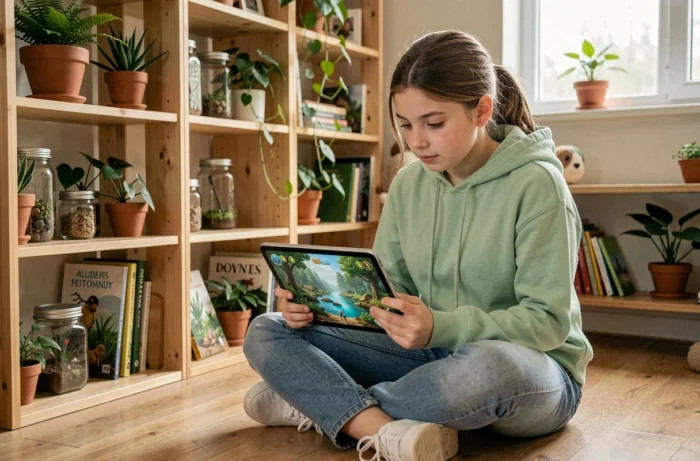
Sorting virtual waste, managing a nature reserve on screen, or answering a quiz about local biodiversity: online educational games allow for a hands-on approach to ecology, without a lecture. The digital format provides immediate feedback on each action, which reinforces concepts much faster than simple reading.
Game mechanics that instill ecological reflexes
Have you ever noticed that a child remembers a game rule better than a school instruction? This principle also applies to adults. An online game about ecology leverages three specific cognitive triggers.
The first is the action-consequence loop visible on screen. When a player throws waste into the wrong virtual bin, the pollution gauge increases. This instant feedback creates a direct link between the action and its impact, a connection that reality often makes invisible.
The second trigger is progression through levels. Unlocking a level requires mastering the previous one. A quiz on selective sorting, for example, starts with common packaging before addressing electronic waste or composting.
The third trigger is competition or cooperation among players. Some platforms offer collective challenges where each participant contributes to a common goal, such as reducing a fictional carbon footprint. The social dimension transforms a solitary exercise into a shared project. Accessible resources on ecosysgame.fr illustrate this approach well by combining ecological scenarios with collaborative game mechanics.

Online ecological games: formats tailored to age and objectives
Not all educational games about the environment are created equal. The choice depends on the target audience and the behavior one wishes to encourage.
Quizzes and memory games for the youngest
For children as young as four or five years old, short formats work best. A biodiversity memory game, like the one developed by the Burgundy-Franche-Comté Regional Biodiversity Agency, pairs images of local species with their names. The child learns to recognize the fauna and flora of their region without realizing it.
Interactive quizzes on everyday eco-friendly actions (water savings, waste sorting, food waste) are also suitable for this age group. Each correct answer reinforces a concrete habit, transferable to real life.
Simulations and management games for teenagers and adults
Environmental simulation games require managing resources over time. The player oversees a territory, balancing economic development and nature preservation, experiencing the consequences of their choices over several rounds.
This format is suitable for teenagers and adults because it replicates the real complexity of ecological issues. Managing a fictional carbon budget forces prioritization, just as a local government would do.
Digital pathways rooted in the territory: a recent trend
An interesting phenomenon is emerging from local communities. Several French regions are now funding playful digital pathways accessible via smartphones or tablets, integrated into public spaces.
The Explor Games “Rebels 3R” in Mâcon is a concrete example. This immersive pathway, co-financed by the Mâconnais-Beaujolais agglomeration and the Burgundy-Franche-Comté Region, addresses waste reduction, combating food waste, and preserving natural resources. The player physically moves through the city while solving puzzles on their screen.
The digital game steps out of the screen to connect with the real world. This hybridization between the real and virtual worlds enhances learning: the player sees, touches, and understands the environment they are meant to protect.
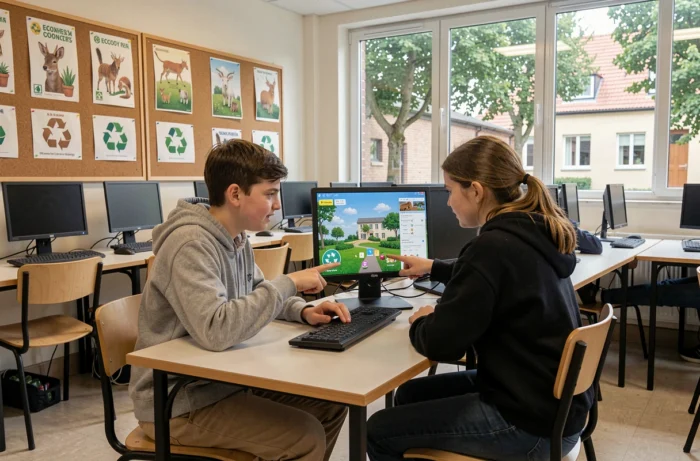
Criteria for choosing an online educational game about the environment
With the proliferation of offerings, it becomes useful to distinguish a truly educational game from mere entertainment dressed in green. Here are the points to check before diving in:
- Reliability of scientific content: does the game cite its sources? Are the information on climate, biodiversity, or waste validated by a recognized organization?
- Progression mechanics: does the player learn something new at each level, or do they repeat the same actions with different graphics?
- Transferability of skills: can the actions learned in the game be replicated in daily life (sorting, composting, energy savings)?
- Age adaptability: a game aimed at six-year-olds shouldn’t overwhelm the user with complex numerical data, and conversely, a game for adults shouldn’t be limited to binary answers.
A game that meets these four criteria is likely to produce lasting learning, not just a pleasant moment in front of the screen.
Limitations to keep in mind
Online gaming does not replace direct contact with nature. A child who spends an hour sorting virtual waste but never goes out into the forest risks developing an abstract knowledge, disconnected from living things.
Screen time also raises questions, especially for the youngest. Alternating digital games and outdoor activities remains the most effective combination for instilling ecological behaviors in the long term.
Online educational games about ecology are improving in quality and diversity, from simple quizzes for toddlers to territorial simulations for adults. Their strength lies in the action-consequence loop, which makes tangible what speeches struggle to convey. The most relevant approach remains to use them as a gateway to concrete actions, not as an end in itself.