
A technician operating a warehouse robot from his smartphone, a SaaS publisher discovering that its AI tool must comply with European regulations while its servers are in Texas: the tech innovations of 2026 are no longer just about spectacular announcements. They raise immediate operational questions, and we can no longer settle for reading trend lists without checking what is actually changing on the ground.
AI Act and compliance: the regulatory filter that every tech project must integrate
Before discussing new tools, we must address what conditions their deployment. The European AI Act has entered a phase of operational implementation. The rules on prohibited practices, general-purpose AI models, and transparency are already applicable, even though the timeline for “high-risk” obligations has been postponed.
This postponement does not mean a global reprieve. Documentation and traceability are becoming selection criteria for AI models, even for companies that do not consider themselves AI players. A publisher integrating a language model into its product must now be able to justify the source of the training data and the associated control mechanisms.
The most underestimated aspect remains the extraterritorial scope of the text. A company established outside the European Union is concerned as soon as the results of its system are used in the EU. For cloud platforms, international model providers, and SaaS publishers, this means that the geographical scope of use determines the legality of the product.
You can follow the latest advancements in components, software solutions, and tech products on the tech page of Mega REF, which gathers useful references to cross innovation and on-the-ground feasibility.
Agentic AI in production: what works and what gets stuck

The concept of agentic AI (software agents capable of executing end-to-end tasks without human intervention at every step) has moved from the demonstration stage to actual deployment in some companies. Specifically, we are talking about workflows where an agent can place a supplier order, generate an anomaly report, or coordinate several microservices to resolve a support ticket.
The real issue in 2026 is no longer the technical capability of these agents, but their orchestration. When multiple agents interact (multi-agent systems), questions of priority, access rights, and decision traceability become complex. The orchestration of AI agents poses more problems than their development.
On the security side, we are no longer just securing a network or an application; we are securing the decisions made by autonomous agents. Feedback on this point varies, as architectures differ significantly from one company to another.
Edge computing and embedded AI: processing data without relying on the cloud
In a logistics warehouse, on a construction site, or in a vehicle, waiting for a response from a remote server is not always acceptable. Edge computing (data processing at the network’s edge) allows AI models to be executed directly on local hardware: sensors, cameras, industrial terminals.
What has changed recently is the miniaturization of chips dedicated to inference. We can now embed image recognition or anomaly detection models on components that maintain low energy consumption. For the industry, this means real-time quality inspections without a permanent connection.
Edge AI reduces latency and network dependence for critical applications. The most mature use cases involve predictive maintenance, intelligent video surveillance, and warehouse robotics. The development of these solutions requires specific skills: optimizing models for constrained hardware, managing remote updates, and delayed synchronization with the central cloud.
Criteria for evaluating an edge AI solution
- Hardware’s ability to execute the model without performance degradation, even after several months without updates
- Compatibility with existing security protocols on-site (local encryption, terminal authentication)
- Ability to re-train or refine the model using locally collected data, without sending everything back to a data center
Physical robotics driven by AI: where the field stands
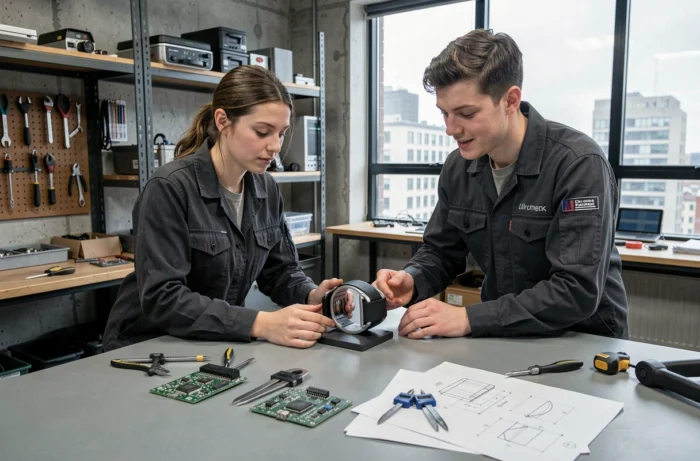
Domestic and industrial robots driven by AI are no longer just show prototypes. Simulating physical environments before actual commissioning allows for calibration time savings and reduces the risk of damage on-site.
In the industrial field, autonomous mobile robots (AMRs) are already managing internal transport in warehouses. The novelty lies in their adaptability: a recent AMR can recalculate its route in real-time in the face of an unexpected obstacle, whereas previous generations would simply stop.
Physical simulation accelerates the deployment of robots in real conditions. For companies considering integrating robotics, the point of vigilance remains software integration with existing systems (ERP, WMS). A high-performing robot that does not communicate with the rest of the software chain creates more friction than it resolves.
Points to check before investing
- Can the robot operate in the real physical environment (dust, temperature, vibrations) without weekly maintenance?
- Are the integration APIs documented and compatible with the management tools already in place?
- Does the provider offer a simulation environment to test scenarios before deployment?
The tech innovations of 2026 are no longer judged solely on their theoretical potential. The ability to go into production within a specific regulatory framework and with real material constraints now makes the difference between an adopted cutting-edge technology and a demonstration that remains in a PowerPoint. For field teams, the search for reliable solutions involves continuous monitoring of components, available applications, and their compatibility with existing systems.