
A change of property manager, a dispute over the distribution of heating charges, a request for an exemption from the individualization of costs: in each of these cases, you will be asked for documents that no one thought to archive. Managing heating in a co-ownership generates a significant amount of technical, contractual, and accounting documents that need to be sorted, classified, and preserved. Without them, it is impossible to justify a decision voted on in a general assembly or to contest an abnormal invoice.
The heating file, a documentary foundation often neglected in co-ownership
Even before discussing minutes or the co-ownership regulations, there is a set of specific documents related to the collective heating system that many co-owners are unaware of. These are grouped under the term heating file, and this is what poses a problem when comparing scenarios for boiler replacement or transitioning to a collective heat pump.
This file includes the operating contract for the heating system along with its amendments, annual maintenance certificates, the history of breakdowns and outages, as well as consumption data from the last three fiscal years (separated from hot water consumption when possible). It also contains hydraulic balancing reports, temperature settings for supply and return, and diagnostic reports related to the heating system (collective DPE, energy audit, PPPT).
Without these documents, a council that wants to vote on a change of energy in a general assembly is working blindly. The service provider proposing a replacement offer needs real consumption data and the state of the hydraulic network. You can consult the advice on Batiwiz to better structure this type of daily archiving.
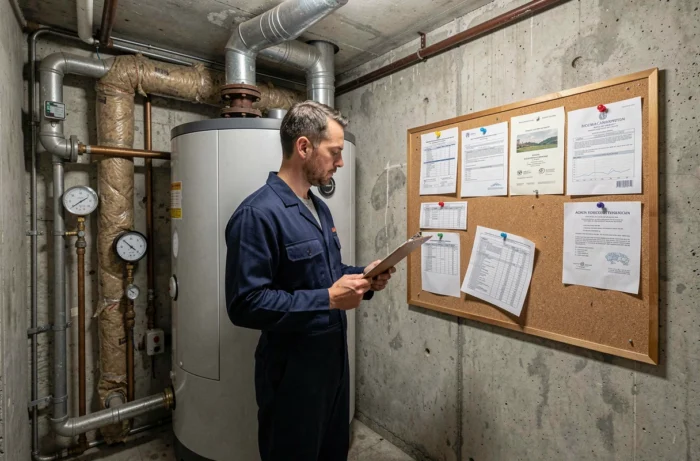
Supporting documents for the exemption from individualization of heating costs
Individualization of heating costs is mandatory in co-ownerships equipped with a collective heating system. Since an order dated June 8, 2023, all devices must be remotely readable by January 1, 2027. However, some co-ownerships may claim an exemption, particularly when the building’s consumption is below the threshold of 80 kWh/m²/year.
The point that most guides gloss over: this exemption cannot be obtained by a simple declaration. A solid supporting file must be compiled, based on documented consumption readings and technical reports proving that the installation makes individualization technically impossible or economically disproportionate.
Which documents to archive to justify an exemption
- Consumption readings over several fiscal years, confirming that the building remains below the regulatory threshold
- The technical report from a study office or heating engineer explaining the impossibility or disproportionate cost of installing individual heat meters
- The resolution of the general assembly recording the choice not to individualize, along with the signed minutes
- Any correspondence with the property manager related to this decision
If a control occurs or if a co-owner contests the distribution of charges, these documents constitute the only admissible evidence. Responses vary on this point depending on the co-ownerships, but the absence of a structured file exposes the co-ownership association to penalties.
Retention period for heating-related archives in co-ownership
The legal retention period for documents related to co-ownership is five years. This period, aligned since the ELAN law of 2018, covers proof of payment for co-ownership charges, correspondence with the property manager, and minutes of general assemblies.
For documents specific to heating, the logic is the same but practice requires going further. Keeping consumption records for at least three fiscal years is a minimum to document a trend, but retaining readings for five to ten years allows for defending a technical choice in court or negotiating an operating contract with full knowledge of the facts.
What is often forgotten in heating archives
The maintenance contract for the gas boiler and its renewals often fall by the wayside during a change of property manager. Annual maintenance certificates do too. Yet these are documents requested by insurance in the event of a claim related to the heating installation.
Energy audit reports or collective DPEs deserve separate archiving, as they serve as the basis for the multi-year work plan. Losing a collective DPE necessitates creating a new one, with the cost that this entails for all co-owners.

Concrete organization of heating document archiving
The property manager is responsible for maintaining and updating the maintenance log of the co-ownership. However, in practice, the council must verify that the heating documents are included. A maintenance log that mentions facade renovation but forgets the replacement of the collective boiler burner has only partial utility.
The most reliable approach is to create a dedicated heating file, separate from the general maintenance log, with a simple structure: ongoing contracts, maintenance history, consumption by fiscal year, general assembly resolutions related to heating, and energy diagnostic reports.
Each document added to this file should bear the date of the corresponding general assembly or technical intervention. This traceability allows the council to prepare future general assemblies with reliable data, and enables the property manager to respond quickly to any request from a co-owner.
A building whose heating archives are complete negotiates its operating contracts better and anticipates regulatory obligations, such as the deadline for remote reading by January 1, 2027. Conversely, reconstructing a technical history afterward costs time, money, and weakens the co-ownership in relation to its service providers and the administration.