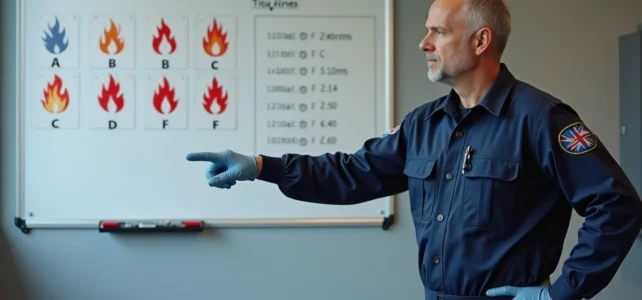
The classification of fires in Europe is based on five main classes (A, B, C, D, F), but this nomenclature still coexists with North American variants (A, B, C, D, K) and outdated designations including a class E for electrical fires. This confusion of reference frameworks complicates the choice of extinguishing agents and staff training. Here, we will address the technical points that general guides overlook.
Euroclasses of fire reaction and fire classes: two distinct reference frameworks
A recurring mistake is to confuse the euroclasses of fire reaction of materials (A1 to F, with supplements s1 to s3 for smoke and d0 to d2 for flaming droplets) with the fire classes related to the fuel. The euroclasses describe a construction material’s contribution to the spread of a fire, not the nature of the fuel involved.
A panel classified A2-s1,d0 means it contributes very little to the fire, emits little smoke, and does not produce flaming droplets. This information is useful for construction prescribers and control offices for building compliance, particularly in ERP.
The fire classes (A to F), on the other hand, determine which extinguisher to use in the event of a declared fire. Mixing these two systems leads to specification errors on construction sites and in fire safety plans. We recommend systematically specifying the reference framework used in any internal technical document.
For everything you need to know about fire class C and its specificities related to gases, the operational specifics deserve particular attention given the risk of explosion.
Class F and cooking fires: why conventional extinguishers are not enough
Cooking oil and grease fires constitute class F in European nomenclature. A standard water spray extinguisher is counterproductive for this type of fire: spraying water on oil that has exceeded its auto-ignition point causes explosive vaporization, resulting in the projection of flaming droplets.
The appropriate agent is a wet chemical product, typically based on potassium acetate. This compound reacts with fats through saponification, forming a soap layer that smothers the flames and lowers the surface temperature. Extinguishers marked class F are the only ones validated for this use.
Fire blankets also represent a first aid solution in professional kitchens. The principle is simple: cut off the oxygen supply by mechanical smothering. Their effectiveness depends on the fit to the container and the speed of intervention before the fire spreads to hoods and extraction ducts.
Common mistake in collective catering
We regularly observe kitchens equipped with ABC powder extinguishers positioned as a universal solution. In a fryer fire, the powder can disperse flaming fats without cooling them sufficiently. The ABC powder extinguisher does not replace a class F extinguisher in the kitchen.
Gas fires class C: cut off before extinguishing
The documented operational priority for a gas fire is to cut off the supply before any attempt to extinguish. Extinguishing the flame without removing the gas source leaves a flammable mixture in the atmosphere, with a risk of re-ignition or explosion.
BC or ABC powder extinguishers can control a gas fire when the supply cut-off is not immediately possible. Water is prohibited. CO2 can be used in confined spaces, but its limited range makes it unsuitable for outdoor use.
- Shut off the gas supply valve if accessible without danger, then monitor for any residual leaks with an appropriate detector
- Ventilate the area after extinguishing to disperse residual gas and prevent the formation of an explosive atmosphere
- Never reignite electrical equipment or open flames before confirming the absence of gas through instrumented measurement
Post-extinction monitoring is as critical as the extinction itself: an undetected residual leak in a closed room can reach the lower explosive limit within minutes.
Metal fires class D and lithium batteries: specific extinguishing agents
Metal fires (class D) involve materials such as magnesium, powdered aluminum, sodium, or titanium. These fires reach very high temperatures and react violently with water, which decomposes into hydrogen and oxygen, fueling the combustion.
Only special class D powders are approved for these fires. They act by smothering, forming an insulating crust on the surface of the molten metal. ABC powders are ineffective and potentially dangerous in this case.
Lithium-ion batteries: an emerging class
The ISO 3941:2026 standard introduces a class L dedicated to lithium-ion battery fires. These fires present thermal runaway that releases flammable and toxic gases. Conventional extinguishing agents do not always succeed in stopping the internal chain reaction within the cells.
- Large amounts of water are still recommended for the external cooling of batteries in thermal runaway, despite the risks of electrolysis
- Specific extinguishing blankets and submerged containment bins are used in logistics and the automotive industry
- Thermal runaway can resume several hours after apparent extinguishment, necessitating prolonged monitoring
The addition of this class L reflects the rapid evolution of fire risks related to the electrification of transport and energy storage.

Choosing an extinguisher according to the fire class: compatibility table
| Fire class | Fuel | Suitable extinguishing agents | Prohibited agents |
|---|---|---|---|
| A | Solids (wood, paper, fabric) | Water, water + additive, foam, ABC powder | CO2 alone (ineffective on embers) |
| B | Flammable liquids | Foam, ABC/BC powder, CO2 | Water jet (spreading) |
| C | Gases | BC/ABC powder, CO2 | Water, foam |
| D | Metals | Special class D powder | Water, CO2, ABC powder |
| F | Cooking oils and fats | Wet chemical agent | Water, ABC powder |
This table summarizes the compatibilities, but each site must adapt its extinguisher inventory to the actual risks present. A warehouse storing lithium batteries does not have the same needs as a central kitchen or a magnesium machining workshop. Compliance requires a specific risk analysis, not generic equipment.