
Preparing a trip calmly anywhere in the world starts with checks that most guides overlook. Entry requirements, actual medical coverage, transporting medications: these technical points are much more crucial for departure than the choice of suitcase or itinerary.
Medications while traveling: customs regulations and international nonproprietary name
A regular treatment is not automatically transportable from one country to another. The French Ministry of Europe and Foreign Affairs recommends keeping each medication in its original packaging, accompanied by a prescription mentioning the international nonproprietary name (INN).
Also, check that your substances are allowed in the country you are visiting. We recommend cross-referencing the country sheets from the ministry with the list of regulated substances published by the local health authority.
For travelers who regularly consult the Travel Guide, these pharmacological checks are part of the standard preparation process, just like ensuring the validity of the passport.
Travel insurance and medical expenses abroad: what the credit card does not cover

The coverage included with a credit card or plane ticket often leads to the belief that protection is sufficient. The Ministry of Foreign Affairs emphasizes that medical, hospitalization, and repatriation costs can be very high depending on the destination. A medical evacuation from Southeast Asia or Southern Africa represents an amount that the standard guarantee of a card does not cover.
Before each departure, examine three points in your contract:
- The daily and per-stay hospital coverage limit, which must correspond to the actual cost of care in the visited country
- The inclusion or not of medical repatriation, including by air ambulance if necessary
- The exclusions related to the activities practiced (high-altitude hiking, diving, motor sports)
A dedicated travel insurance remains the only reliable way to cover these risks. Compare contracts based on actual limits, not on the monthly premium price.
Entry requirements and vaccination: checks that travelers neglect
Entry requirements are not limited to a visa and a valid passport. The ministry recommends checking that the vaccines in the French schedule are up to date even before considering vaccinations specific to the destination. Diphtheria, tetanus, polio, whooping cough: these forgotten boosters can pose problems during an extended stay.
Some countries require proof of vaccination against yellow fever, including for travelers in simple transit from an endemic area. This requirement varies depending on the country of origin, not just the final destination. A traveler departing from France with a stopover in Nairobi may be denied entry into a third country without a vaccination certificate.

Plan vaccinations several months before departure. Some protocols require injections spaced weeks apart, which are incompatible with last-minute preparations.
Passport validity: the six-month rule
Many countries deny entry to travelers whose passports expire less than six months after the planned return date. This rule is not universal, but it concerns enough destinations to justify early renewal. In France, processing times vary depending on the period and the prefecture.
Entry/Exit System and border checks in Europe: what changes for travelers
The European Union’s Entry/Exit System (EES) modifies the procedures for crossing the external borders of the Schengen area.
For French travelers, the direct impact remains limited. However, those traveling with relatives of non-European nationality should anticipate potentially longer processing times during the system’s ramp-up. The initial deployments at border crossing points lead to logistical adjustments in airports and ports.
Preparing a realistic travel budget by destination
The budget conditions the serenity of the stay as much as the formalities. Rather than a global envelope, break down your expenses by category: accommodation, local transport, food, activities, and a margin for unforeseen events. The margin for unexpected costs is not a luxury: it absorbs the extra costs related to health or logistical contingencies.
Find out about the accepted payment methods locally. In several countries in Southeast Asia and Africa, cash payments remain dominant outside tourist areas. Plan for a credit card with no foreign exchange fees and a minimum amount of local currency upon arrival.
- Check the withdrawal fees applied by your bank and local ATMs before departure
- Bring a second credit card on a different network (Visa and Mastercard) in case of blockage
- Keep a photocopy of your identity documents separate from your originals, ideally in an encrypted digital version
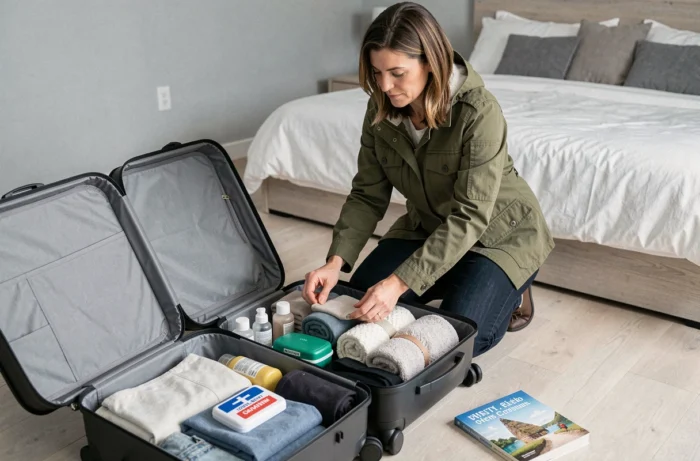
Preparing for a calm trip relies less on lists of items to bring than on regulatory and financial checks made in advance. A medication confiscated at customs or an uncovered hospitalization can turn a stay into a trial. These checks take a few hours before departure, preventing weeks of complications on-site.