
Preparing a trip is not just about choosing a destination on a map. The choice of pace, season, and type of experience sought weighs as much as the country itself. Successfully navigating your upcoming travels around the world requires considering several concrete criteria before booking anything.
Slow travel and digital detox: what will change the way we travel in 2026
Have you ever felt that fatigue after a trip where each day was timed, and every monument checked off a list? This feeling fuels an underlying trend.
The DERTOUR Group Travel Trend Report 2026 confirms this evolution: slow travel is gaining ground among European travelers. The principle: stay longer in fewer places, take the time to get to know a neighborhood, a market, a local rhythm.
This report also describes the emergence of the JOMO (Joy of Missing Out) profile. Opposite to FOMO, this traveler embraces doing less to live better. Nearly half of respondents view vacations as a deliberate way to disconnect from social media.
Rather than five cities in ten days, a ten-day stay in a single region allows for discovering local spots, making connections, and returning with a true understanding of the place. Resources like leblogdevoyage.fr help identify these destinations conducive to immersion rather than a race to see monuments.

Traveling off-season: budget, attendance, and climate to balance
Traveling in the low season does not mean accepting rain for two weeks. It is a balance between three parameters that deserves understanding before booking.
The budget-climate-attendance triangle
In high season, accommodation prices soar, tourist sites become crowded, and heat can be excessive in certain regions. Traveling off-peak reduces these three constraints simultaneously.
The European Travel Commission (ETC) also documents an increase in off-season travel in Europe compared to previous years. It is no longer a niche choice.
What criteria to check before booking off-season
- The actual weather on-site: a tropical country in “low season” can offer sunny mornings and brief afternoon showers, which remains very manageable
- The availability of sites and services: some accommodations, restaurants, or ferry services close outside of high season, check before you go
- Local events: festivals, religious holidays, or seasonal markets can transform an off-season stay into a richer experience than high season
Southeast Asia illustrates this balance well. The rainy season in Vietnam or Thailand corresponds to significantly lower rates, reduced attendance, and a climate that remains pleasant in certain regions.
Responsible tourism: concrete actions that change a trip
The ETC report shows a simultaneous increase in four indicators: green travel, off-the-beaten-path destinations, engagement with local communities, and travel outside of high season. But what does “responsible travel” mean when planning a trip?
The choice of transport weighs more than any other decision on the footprint of a trip. The ETC notes an increase in the use of low-carbon land transport modes, such as trains, for intra-European journeys.
Choosing locally managed accommodation over an international chain directly redistributes tourism revenue into the local economy. It is a simple lever that requires no sacrifice in comfort.
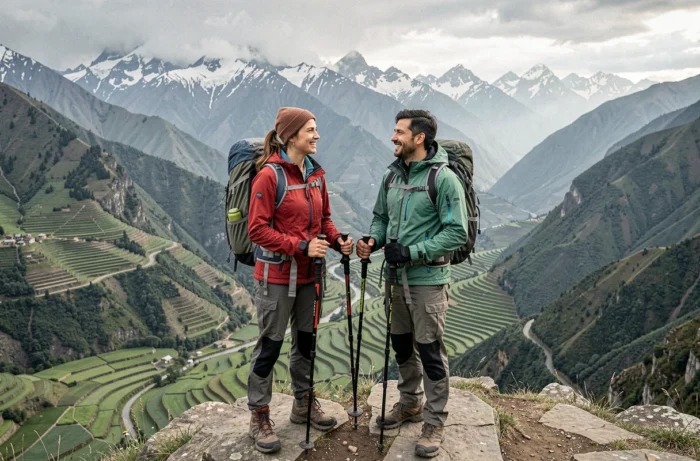
The “love local” concept applied to travel
Buying at local markets, choosing a local guide, dining in neighborhood restaurants: these choices may seem anecdotal when taken in isolation. Cumulatively over a ten-day stay, they direct a significant portion of the budget towards the local population.
Some lesser-known destinations in Europe are capitalizing on this trend and gradually attracting travelers in search of authenticity.
Building a solid itinerary: method and pitfalls to avoid
A good itinerary is not built by stacking points of interest on a map. Why do some trips leave a feeling of frustration despite beautiful destinations? Often because the pace was poorly calibrated.
- Counting transfer days as “lost” days: a six-hour bus ride in Laos or Peru takes up half a day, it needs to be integrated into the planning
- Planning at least one free day for every five: it is during these free days that the best discoveries happen
- Never book all accommodations in advance in countries where supply is abundant: keeping flexibility allows for extending a stop that you enjoy
- Check visa conditions and health requirements at least two months before departure, not two weeks
The classic pitfall for a first trip to Asia or South America is wanting to see everything. Three well-explored regions are worth more than eight skimmed cities.
A successful itinerary leaves room for the unexpected. It is often the conversation with a local, the unplanned detour, or the rest day that define the best travel memories.
Current trends, from slow travel to off-season tourism, all point in the same direction: travel less quickly, choose better, and stay longer.