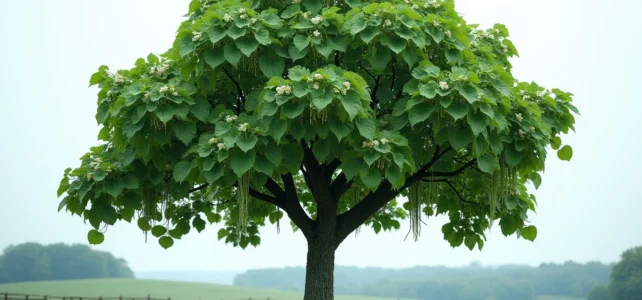
You may have already encountered this tree around a park without knowing its name. Large heart-shaped leaves, clusters of white speckled flowers, and then strange hanging pods that resemble giant beans. The catalpa tree is unlike any other deciduous tree in Europe, and for good reason: it is not from here.
A Cherokee name for a sacred tree of Native Americans
The word “catalpa” comes directly from the Cherokee language. According to passed-down stories, the term kutuhlpa referred to “winged heads”, an allusion to the bell-shaped flowers of the tree. Other sources attribute the word to the meaning “bean” in Cherokee, referring to the long pods that the tree produces after flowering.
The catalpa was a sacred tree for several Native American tribes. The Catawba of South Carolina particularly revered it. This people actually gave rise to a lasting linguistic confusion: some botanists thought that “catalpa” derived from the name of this tribe. The naturalist Mark Catesby, who described the tree in the 18th century, may have contributed to this misunderstanding by inaccurately transcribing the Native American name.
To delve deeper into the history and origin of the catalpa tree, one must go back to the time when European botanists were discovering North America’s flora with a mix of fascination and hasty classification.
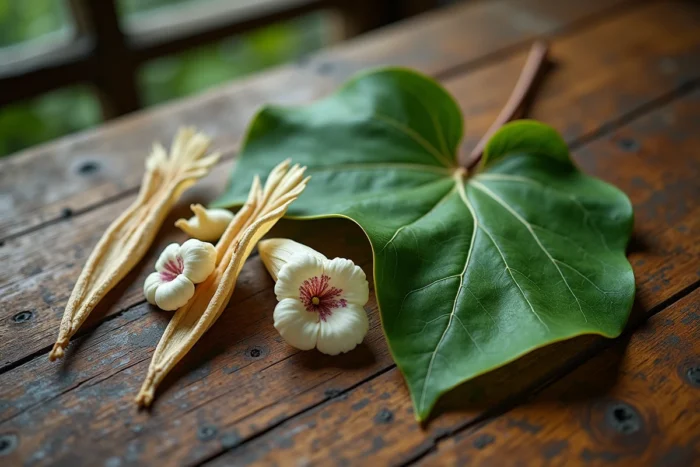
Catalpa bignonioides and catalpa speciosa: two species, two paths
When talking about catalpa in Europe, it most often refers to Catalpa bignonioides, native to the southeastern United States. It is the most common species found in French parks and gardens. Its cousin, Catalpa speciosa, grows naturally further north, in the states of Indiana, Arkansas, and Tennessee.
The difference between the two is not immediately obvious to a passerby. The speciosa is larger, with slightly broader leaves and a somewhat earlier flowering. Its wood, more resistant to rot, was used by American settlers to make fence posts and railroad ties.
The bignonioides, on the other hand, has mainly traveled as an ornamental tree. Introduced to France probably through royal gardens, it has adapted to the European temperate climate with remarkable ease. The National Museum of Natural History mentions it as a tree well-suited to urban life.
Why the catalpa belongs to a tropical family
Here’s a surprising detail: the catalpa is part of the Bignoniaceae family, which is primarily tropical. It is one of the very few members of this family that has managed to establish itself in the temperate zones of North America. Its large trumpet-shaped flowers and long pods betray this kinship with vines and trees from equatorial forests.
This tropical origin also explains why the catalpa buds late in spring and loses its leaves early in autumn. Its growing season is short compared to oaks or maples. It waits for late frosts to pass before unfolding its foliage.
The catalpa in the city: a shade tree against heat waves
The catalpa has long been planted for its purely decorative qualities. Its white flowers speckled with purple and yellow, grouped in upright panicles, offer a brief but striking display in early summer. Its leaves, among the largest of all trees cultivated in France, create dense shade.
In recent years, this shade has become a significant planting argument. Several municipalities and gardeners now present it as a tree capable of mitigating summer heat in schoolyards, squares, and private gardens. Its large leaves intercept a significant portion of direct solar radiation.
- Heart-shaped leaves that can exceed the size of an adult hand, maximizing the shaded area on the ground
- Tolerance to compacted urban soils and moderate drought episodes, provided that the base is mulched
- Honey-producing flowers that attract pollinators in the city, at a time when few trees are still in bloom
A recurring observation from recent gardener testimonials is that the catalpa thrives better when the soil is improved and mulched at the base, particularly with grass clippings or wood chips. In poor, rocky soil, its growth slows significantly.
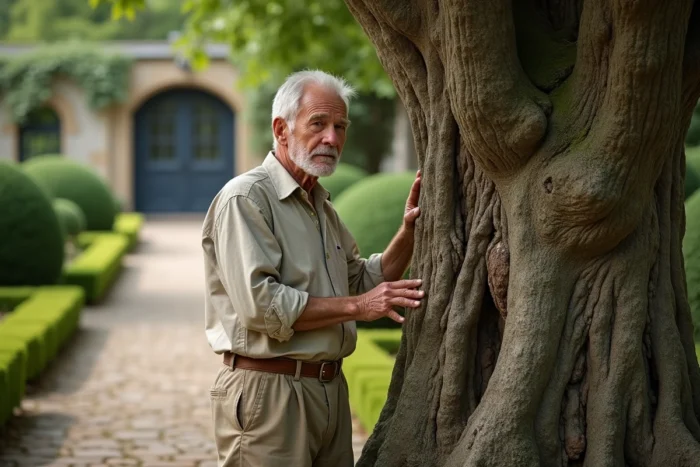
Label “remarkable tree”: the catalpa enters the heritage
The catalpa is no longer just a garden tree. In 2025, a Catalpa speciosa from the abbey of Beaulieu-en-Rouergue, in Tarn-et-Garonne, received the label “remarkable tree” awarded by the A.R.B.R.E.S. association. This distinction rewards specimens deemed exceptional for their age, size, or historical value.
The tree from Beaulieu-en-Rouergue stands 27 meters tall. In Tarn-et-Garonne, only two other trees had received this labeling before it: a pedunculate oak in Merles and a yew in Caylus. The catalpa thus joins the protected plant heritage of the region.
In Montreal, on the campus of McGill University, another Catalpa speciosa is classified as a remarkable tree of Mount Royal. Its trunk diameter reaches 75 centimeters. These official recognitions show that the catalpa transcends the simple status of a decorative tree to become a living witness of garden history.
A tree that regenerates with age
Old catalpas possess an astonishing ability. When they lose a main branch, they fill the void in their crown by producing new vertical shoots. These vigorous sprouts give the impression that young trees are growing on the old individual.
Some specimens develop a hollow trunk over time, without compromising their survival. They then create an internal network of aerial roots, a kind of biological wiring that reinforces the weakened structure. This resilience partly explains why some catalpas reach an advanced age despite sometimes difficult conditions.
- Ability to produce vertical shoots after losing a branch, reforming the crown
- Hollow trunks compensated by internal roots, a phenomenon observable in very old specimens
- Wood naturally resistant to rot, especially in Catalpa speciosa
The catalpa tells a story that crosses continents. Sacred tree of the Cherokees and Catawba, botanical curiosity of European gardens, then ally against urban heat, it has changed roles throughout the ages without losing what makes it immediately recognizable: its oversized leaves, porcelain-like flowers, and endless pods that sway all winter long.