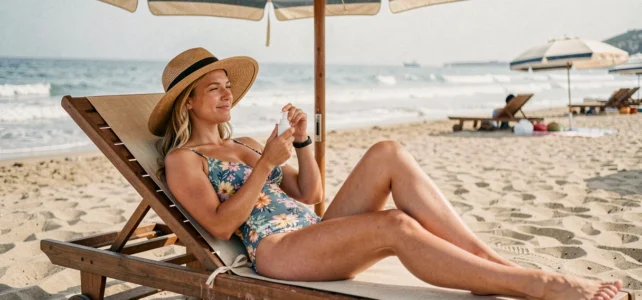
You are lying under your parasol, in the shade, and yet your skin has changed color by the end of the day. This is not just an impression: tanning under a parasol is a very real phenomenon, linked to mechanisms that the fabric alone is not sufficient to block. Understanding these mechanisms allows you to enjoy the sun without putting your skin in danger.
Diffuse radiation and reflection: why the parasol does not filter everything
You may have noticed that even on a cloudy day, sunburn is still possible? It is the diffuse UV radiation that is responsible for this. Ultraviolet rays do not only come in a straight line from the sun. They bounce off the atmosphere, clouds, and arrive under your parasol from the sides.
Sand, water, and light concrete amplify this phenomenon through reflection. Sand reflects a significant portion of UV rays back to your skin, even if you are perfectly in the shade. On a light tiled terrace, the effect is similar.
A classic parasol, without specific treatment, reduces direct exposure but allows some UV rays to pass through the fabric. The shade of a parasol does not eliminate UV exposure, it reduces it. The difference between tanning in the sun and tanning under a parasol is a matter of dose, not nature.
For those who want to tan under a parasol safely, it is therefore necessary to act on several levers at the same time, not just rely on shade.
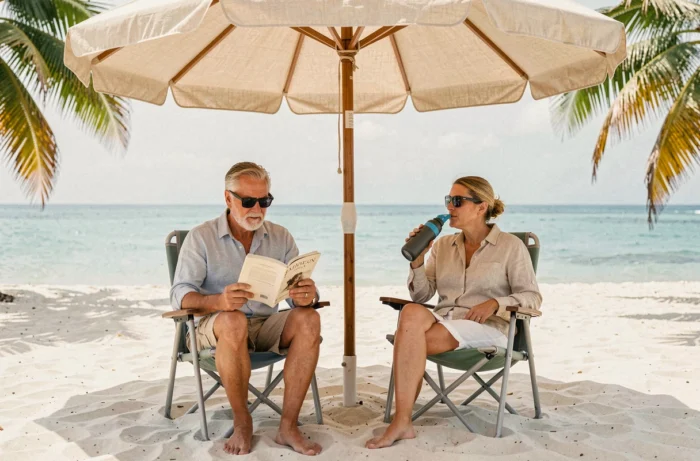
UPF index of the parasol: the criterion that most buyers overlook
When buying a parasol, we look at the size, color, price. Rarely the UV protection index of the fabric. Yet this is the factor that makes the real difference.
The UPF (Ultraviolet Protection Factor) measures a fabric’s ability to filter UV rays. A UPF 50+ parasol blocks more than 98% of UVA and UVB rays that would pass through the fabric. This is the reference level recommended by manufacturers specializing in 2025-2026.
In contrast, a cheap fabric without UPF mention offers mainly visual protection. You have shade, you feel less heat, but UV rays pass through the fabric without difficulty. Thermal comfort has nothing to do with sun protection.
How to check the UPF before purchase
Look for the UPF mention on the product sheet or label. If it is not there, assume that the fabric does not effectively filter UV rays. Parasols intended for professionals in the restaurant industry now display this data, as it meets a verifiable anti-UV textile standard.
The color of the fabric also influences filtration. Dark shades (navy blue, black, dark green) absorb more radiation than light colors. A white or beige parasol lets in more UV than a dark-colored model, with the same fabric thickness.
Sun protection under a parasol: cream, clothing, and timing
Even under a UPF 50+ parasol, diffuse radiation and reflection continue to reach your skin. Sun protection remains necessary. Here are the concrete actions to combine:
- Apply sunscreen suitable for your skin type, even under the parasol. Diffuse UV rays are enough to cause sunburn on unprotected skin, especially on exposed areas like shoulders and face.
- Reapply every two hours, and after each swim. The cream loses its effectiveness with sweat and contact with water.
- Wear a wide-brimmed hat and UV-filtering sunglasses. The eyes are particularly vulnerable to radiation reflected by sand or water.
- Opt for lightweight clothing that covers the shoulders, especially for children whose skin is more sensitive to UV.
These precautions apply to any prolonged exposure, even in the shade. The gradual tanning obtained under a well-chosen parasol is gentler on the skin than direct exposure, provided these basic actions are not neglected.
UV index and time slots: adapting your sun exposure
The UV index is a little-known indicator to the general public, but it radically changes the game. When the UV index exceeds 6, even the shade of a good parasol is not enough to avoid skin damage without additional protection.
Why this threshold? Because at this level, diffuse radiation alone can cause erythema (redness preceding sunburn) in less than an hour on unprotected fair skin. Checking the UV index of the day before heading outside allows you to adjust your precautions.
Organizing your day according to the sun
UV radiation peaks between 12 PM and 4 PM in summer. If you want to tan under your parasol with minimal risk, the time slots before 11 AM and after 4 PM are preferable. The light remains sufficient to stimulate melanin, but the UV intensity is much lower.
Tanning under a parasol outside peak hours reduces the risk of skin cancer while allowing for gradual coloring. This is a compromise that dermatologists recommend for those who do not want to give up their summer tan.
For children, caution is even greater. Their skin produces less melanin and their solar capital is limited. A UPF 50+ parasol, combined with high-protection sunscreen and covering clothing, is the minimum for prolonged outdoor outings.
Skin hydration and the effect of tanning over time
A lasting tan does not only depend on exposure. A well-hydrated skin retains melanin longer and peels less quickly. Applying a moisturizing treatment after each exposure, even moderate, helps prolong the tan.
Water also plays a direct role. Dehydrated skin is more vulnerable to UV rays and heals less well in case of mild burns. Drinking regularly during exposure, especially in high heat, protects both the body and the skin.
A well-chosen and well-used parasol allows for a more even tan than direct exposure. The dose of UV received being lower, melanin distributes more evenly, without the burn marks that create irregular areas.
The right reflex for summer: check the UPF of your parasol, keep your sunscreen handy, and monitor the UV index of the day. Tanning under a parasol works, provided you treat shade as a complement to protection, not as a guarantee.