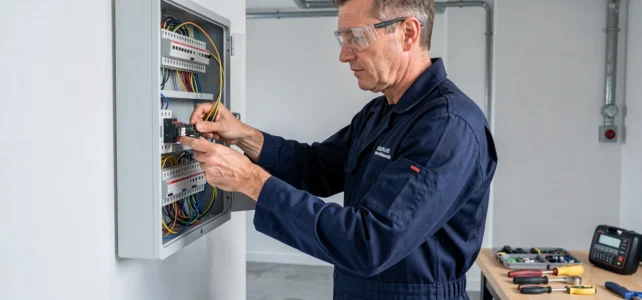
A circuit breaker that trips every time the oven is turned on, a socket that heats up behind the kitchen cabinet, an electrical panel where porcelain fuses coexist with exposed wires: these situations are regularly encountered in homes built before the year 2000. Before even discussing comfort or home automation, the priority remains to secure the existing setup. And for a reliable electrical installation, the choice of service provider makes all the difference.
NF C 15-100 standard version 2024: what changes concretely for your home
The NF C 15-100 standard is no longer a single document. Since August 2024, it has been divided into a series of 21 distinct documents, with a section specifically dedicated to residential buildings. The CONSUEL confirmed in 2025 that this new series is authoritative for any installation for which the building permit, contract, or order is dated after August 31, 2025.
In practice, this means that an electrician working on an extension, a new circuit, or a major renovation must now refer to texts different from those they used two years ago. A provider still working under the old version exposes the site to a compliance refusal.
Among the most concrete new requirements, there is the obligation for a type F differential for circuits powering a heat pump, an electric vehicle charging station (IRVE), or certain dimmers. This was not previously required. If a charging station is installed in a garage in 2026, the panel must include this specific protection, under penalty of non-compliance.
When looking for a professional capable of mastering these updated requirements, Electriciret’s home services specifically cover this type of intervention, from bringing the panel up to standard to adding circuits compliant with the 2024 series.

Electrical diagnosis and compliance: pitfalls to avoid
The electrical diagnosis is mandatory for any sale or rental of a property whose installation is over 15 years old. It is carried out by a certified diagnostician, who checks the presence and proper functioning of protective devices: main circuit breaker, differential switches, grounding.
Difference between diagnosis and compliance
People often confuse the two. The diagnosis identifies anomalies, but it does not obligate the seller to carry out repairs. The buyer takes the property with full knowledge of the situation. However, for a landlord, certain serious anomalies (lack of grounding, accessible live wires) can render the property indecent under the law.
Compliance, on the other hand, involves correcting these anomalies so that the installation meets current standards. In practice, it is observed that the majority of interventions focus on three recurring points:
- Replacing old fuses with circuit breakers, which are the only ones allowed in current installations
- Adding or restoring the grounding circuit, often absent or degraded in homes built before 1990
- Separating circuits (lighting, sockets, large appliances) onto dedicated protections, where sometimes a single circuit breaker powered an entire floor
Impact of the DPE on electrical work
With the changes to the energy performance diagnosis planned for 2027, homes heated with electricity will benefit from a rebalancing in the calculation of labels. Specifically, switching from gas heating to an electric heat pump can improve the DPE rating, but this requires a panel sized to support these new circuits. You cannot connect a heat pump to a six-module panel from 1985.
Electrical panel: the technical heart of a reliable installation
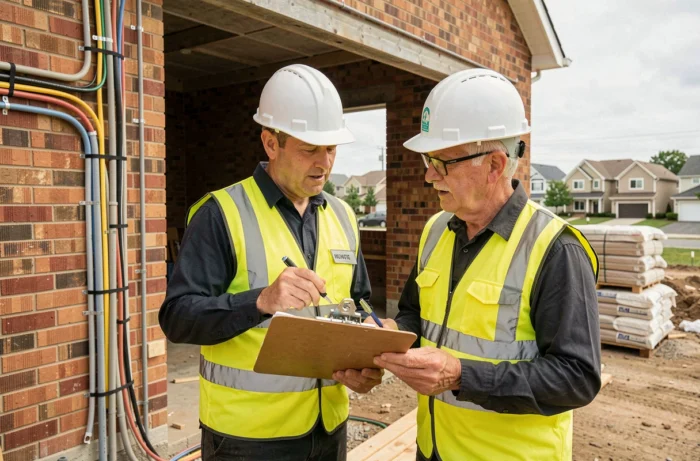
The panel is the first element that a competent electrician inspects upon arriving at a site. Its capacity, organization, and the quality of its protections determine the reliability of the entire installation.
A modern panel for a medium-sized house generally contains at least three rows. The first accommodates the differential switches (type A for specialized circuits, type AC for lighting and sockets, type F for equipment with dimmers or charging stations). The following rows house the circuit breakers, each assigned to a specific circuit.
Each circuit must be identified by a readable label. This may seem basic, but there are still panels where the markings have disappeared, making any subsequent intervention dangerous and time-consuming.
Sizing and module reserve
The standard requires a reserve of at least 20% of free modules in the panel. This margin allows for the addition of a circuit without having to rewire everything: a new charging point, a towel dryer in a renovated bathroom, or a dedicated circuit for a home office with high-demand computer equipment.
Feedback varies on this point, but in practice, planning for 30% reserve offers a more comfortable margin for future changes in the home.
Choosing an electrician for home work: concrete criteria
Beyond the mandatory certifications (Qualifelec qualification, ten-year insurance), some practical elements can help distinguish a rigorous professional from a careless one:
- They conduct a systematic preliminary visit before estimating, to assess the condition of the existing network and identify constraints (cable runs, type of partitions, distance to the panel)
- They provide an up-to-date electrical diagram at the end of the project, a document that will be required during a future diagnosis or resale
- They request or carry out the CONSUEL compliance certificate for new installations or major renovations
- They are familiar with the NF C 15-100 series in its 2024 version and can explain the protections suitable for the planned equipment (heat pump, IRVE, induction cooktops)
A detailed quote, item by item, remains the best indicator of seriousness. A global price without breakdown does not allow for comparison, nor does it verify that each circuit benefits from the appropriate protection.
The electrical installation of a house is not a subject that is resolved once and for all. Uses evolve, standards tighten, and a well-designed panel today will likely need to accommodate new circuits in five or ten years. Relying on a provider who sizes with this perspective avoids reopening walls too soon.