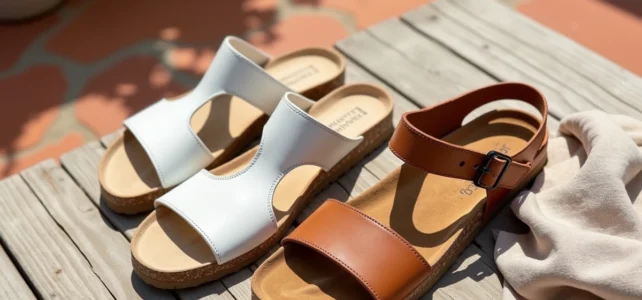
Billowy and Birkenstock share a common niche, that of the summer sandal focused on comfort, but their technical approaches diverge on a fundamental point: the material of the insole. Birkenstock uses a footbed made of cork and molded latex, designed to gradually conform to the shape of the foot. Billowy, a Spanish brand aimed at a younger audience, relies on soft foam soles that provide immediate cushioning without a break-in period.
Cork sole vs foam sole: what changes for the foot
The choice of sole material determines the walking sensation from the very first minutes. The cork footbed of Birkenstock slowly deforms under the influence of body heat and pressure. The first few days may feel firm, sometimes uncomfortable, before the sole takes the imprint of the foot.
Billowy adopts an opposite logic. The compressed foam reacts immediately, with no adaptation needed. Comfort is noticeable from the first try-on, which partly explains the brand’s popularity among parents outfitting their children.
This difference has a direct consequence on durability. Cork, being more rigid, retains its shape and support for several seasons. Foam, on the other hand, tends to sag more quickly under daily use. Over long distances of summer walking, a comparison of muscle fatigue and actual cushioning can reveal notable differences. To delve deeper into this point, a detailed billowy vs birkenstock review helps to better understand the sensations in use.

Billowy or Birkenstock sandals: for which wearer profile
The positioning of the two brands does not target the same needs. Billowy offers a range primarily designed for children and teenagers, with colorful designs, adjustable straps, and a lightweight feel. Adult models exist but are less diverse.
Birkenstock covers a broader spectrum. The Arizona, Madrid, or Gizeh models cater to both teenagers and adults, with options in natural leather, synthetic materials, or vegan versions. The German brand has also developed a range for healthcare professionals, featuring clogs and sandals with reinforced soles.
A often overlooked criterion: foot width
Birkenstock systematically offers two widths per model (regular and narrow), allowing for a more precise fit. Billowy does not communicate as structured on this parameter. For wide feet or individuals suffering from bunions, the choice of width is as important as the choice of model.
Repairability and lifespan of sandals
The question of longevity goes beyond simple seasonal comfort. Birkenstock has structured a resoling service: it is possible to have the outer EVA sole or the inner cork sole replaced by an authorized cobbler. This repairability extends the lifespan of a pair by several years.
Billowy does not offer an equivalent repair program. The glued foam construction makes resoling difficult, if not impossible. A worn pair is generally replaced, raising the question of long-term cost despite a lower initial purchase price.
- Birkenstock: replaceable cork sole, repairable metal buckles, leather that ages without degrading quickly.
- Billowy: non-replaceable foam sole, lightweight synthetic straps but less resistant to prolonged wear.
- Over several summers, the total cost of ownership of a Birkenstock may turn out to be lower despite a higher unit price.
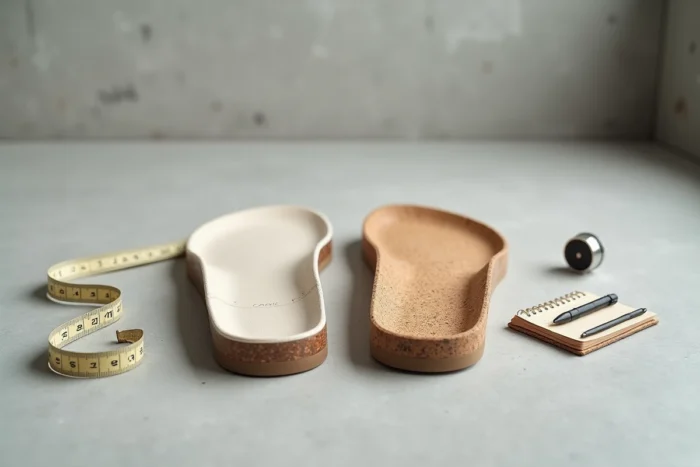
Price and value for money of Billowy and Birkenstock sandals
Price often serves as the first decision filter. Billowy positions itself in an accessible segment, significantly below the average price of a Birkenstock. The gap is marked enough that the choice is approached differently depending on whether one is outfitting a growing child or an adult who will keep the same pair for several summers.
For a child who changes shoe size every year, Billowy offers a logical compromise: decent comfort, reasonable price, attractive design. For an adult seeking durable arch support and a sandal worn daily from May to September, Birkenstock justifies its price through longevity and the possibility of repair.
Comfortable sandals and medical follow-up: a forgotten angle
Individuals being treated for postural disorders or foot pathologies sometimes turn to sandals with anatomical soles. Birkenstock is frequently mentioned by podiatrists as a compatible option with certain treatments, without replacing a custom orthotic. Billowy sandals do not claim this medical positioning.
For wearers who benefit from coverage for foot correction devices, the question of potential reimbursement for orthopedic shoes via the list of products and services (LPP) deserves to be raised with the healthcare professional. Neither Billowy nor Birkenstock are listed as such, but certain orthotic insoles placed in a Birkenstock may be covered.
What choice based on summer use
The Billowy vs Birkenstock comparison is not just a question of brand or price. The usage terrain often cuts through the debate.
- Beach and short outings with children: Billowy, for its lightweight and quick-drying properties.
- Extended urban walking, travel, standing days: Birkenstock, for the structural support of cork and the breathability of leather.
- Mixed city-nature use on uneven terrain: Birkenstock, thanks to the controlled rigidity of the sole that limits fatigue on hard ground.
The market for comfortable sandals is evolving towards multi-use models that combine technical cushioning and aesthetics. High-performance synthetic materials are rising alongside traditional cork.
Birkenstock and Billowy embody two distinct responses to this trend: one through durability and orthopedic support, the other through accessibility and instant comfort. The best pair depends less on the brand than on the frequency of wear, foot type, and the time horizon over which the price is evaluated.