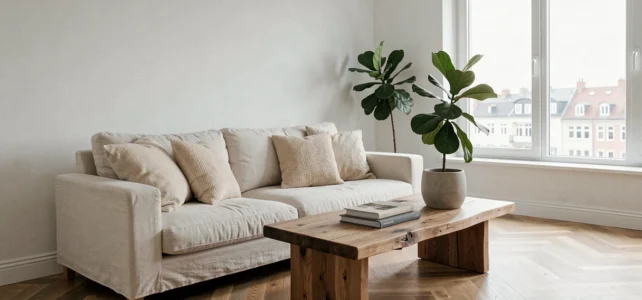
A poorly placed sofa, a wall that’s too white, a lamp that overwhelms the room: sometimes, the problem isn’t the budget but a detail in the layout. The decoration of an interior space relies on simple technical choices, provided you understand how a color, lighting, or a piece of furniture alters the perception of a space. Here are the concrete levers that truly change the atmosphere of an apartment or a house.
Colour drenching: painting an entire room in the same shade
You may have noticed that an accent wall can sometimes visually shrink a room instead of enhancing it? This is the paradox of poorly balanced contrast. Colour drenching proposes the opposite: applying a single color to the walls, ceiling, woodwork, and sometimes even the furniture.
The principle is simple. By eliminating color breaks, the eye no longer clings to the boundaries of the room. The angles disappear, and the volume seems more fluid. This technique, identified as a structuring trend in 2025 by specialized decor press, works particularly well in rooms with modest proportions.
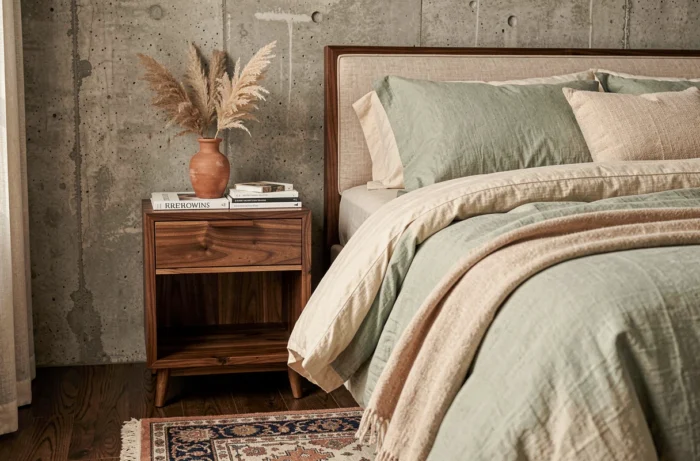
Specifically, take a standard-sized bedroom. Painted white with a teal accent wall, it appears cut off. The same room entirely enveloped in a soft sage green gives a cocooning sensation without visually reducing the volume. There are many layout ideas to explore on the Zen et Déco immo website to adapt this approach to every type of room.
Colour drenching requires a bold color choice. Favor medium tones, neither too light (the enveloping effect disappears) nor too dark (the room can become oppressive without adequate lighting). Matte finishes absorb light and enhance immersion, while a light satin ceiling retains brightness.

Layered lighting: the technique that replaces a single ceiling light
A single central ceiling light casts flat light that flattens reliefs and textures. This is the most common reflex, and the most detrimental for a well-designed interior decoration.
Layering three types of light sources radically transforms the ambiance. Each layer plays a specific role:
- Ambient lighting (diffuse pendant, dimmable ceiling light) provides general light without glare. It replaces the single central lamp with a more homogeneous diffusion.
- Task lighting (desk lamp, reading lamp, spotlight under a kitchen cabinet) targets activity areas. It avoids over-lighting the entire room for reading or cooking.
- Accent lighting (low string lights, floor lamp, LED strip behind a piece of furniture) creates depth. It is what gives the impression that the room has character in the evening.
The combination of these three layers allows you to modulate the atmosphere of a living room or bedroom without moving a single piece of furniture. In terms of home staging before a sale, lighting remains the least expensive and most effective lever to enhance a property.
Furniture and circulation: placing furniture according to traffic flow
Before choosing a furniture style, ask yourself a practical question: where do people move in this room? The circulation dictates everything else. A beautiful sofa placed across the natural flow of movement makes a living room uncomfortable, regardless of its price.
Mental mapping of daily paths (entry to kitchen, hallway to bedroom, door to window) helps identify areas to keep clear. The furniture is organized around these axes, not against them.
In a small apartment, multifunctional furniture changes the game. An entry console that doubles as a desk, a bench with integrated storage, an extendable dining table: each piece of furniture must justify its place on the floor. If a piece of furniture only serves to decorate, it clutters.
For a studio or small two-room apartment, moving the sofa a few centimeters away from the wall can sometimes create an impression of depth. The “floating” furniture in the room, even slightly, breaks the corridor effect created by rows of furniture pressed against the walls.
Materials and textures: what makes a room lively without changing color
Two living rooms painted in the same off-white can give opposite impressions. The difference comes from the materials present in the room. A corduroy sofa, a jute rug, a crumpled linen cushion, a walnut table: the variety of textures creates the visual richness that color alone cannot provide.
The most reliable practical rule is to mix at least three families of materials in each room:
- A soft and absorbent material (fabric, wool, velvet) for tactile comfort.
- A rigid and natural material (wood, stone, ceramic) for visual grounding.
- A reflective or metallic material (brass, glass, mirror) to capture light and add depth.
This mix works in all rooms of the house, from the kitchen to the bedroom. In a renovation or sales context, adding two or three textured elements costs less than a paint change and immediately alters the perception of the property.
A common mistake is to accumulate decorative objects without varying the materials. Ten light wood frames on a white wall produce a monotonous repetition. Replace three with black metal or rattan frames, and the wall gains relief without any painting work.
Decorating an interior space does not require replacing everything. A rethought lighting, repositioned furniture, a few added textures, and a methodically applied color are enough to transform the perception of a space. The last reliable test remains to photograph the room: what looks off on screen also feels off in reality, and what works in photos works for a visitor.