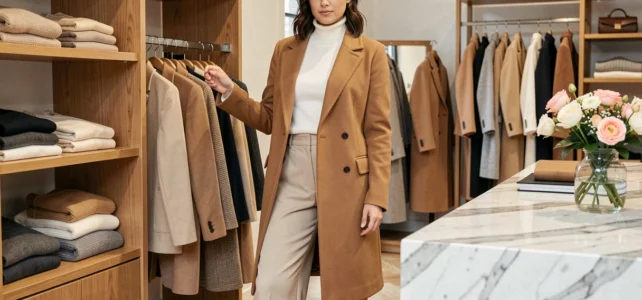
Your closet is overflowing, yet you feel like you have nothing to wear. Most of the time, the pieces are there, but they don’t work together or align with current trends. Embracing the latest fashion trends doesn’t mean buying everything new each season: it’s more about learning to graft a few current elements onto a wardrobe foundation that reflects who you are.
European textile regulation: what changes for your wardrobe
Have you noticed that some brands now offer clothing repair or take-back services? This is not just a marketing gimmick. Since July 2026, large companies in the EU can no longer destroy their unsold textiles. They must prioritize resale, donation, repair, or recycling.
This regulatory constraint alters the very nature of what ends up in stores. Brands are designing pieces intended to last longer, with enhanced requirements for durability, repairability, and recyclability. In practice, collections are becoming more understated and easier to reintroduce into a second-hand circuit.
For you, the benefit is direct. A garment designed to be repairable and durable is a better investment than a disposable piece worn three times. Investing in these new pieces means adopting a fashion trend that won’t be out of style next season.
A European legislative framework also anticipates the introduction of the Digital Product Passport for textiles, gradually starting from the 2027-2028 period. This digital passport will give you access to the exact composition, repairability, and end-of-life information of a garment before you buy it.
When you explore fashion trends on Mister Tendance, keep this filter in mind: a trendy and durable piece is always better than an impulsive purchase that will end up at the back of a drawer.
Building a personal style with targeted trendy pieces
The classic temptation is to copy a complete look seen on a runway or social media. The result is often disappointing because the look was designed for a different body, context, or lighting. The effective approach is more surgical: add a single trendy piece to an outfit you already master.

Let’s take a concrete example. You’re wearing straight jeans and a white t-shirt, a basic that everyone owns. Add a silk scarf tied around your wrist or a colorful belt, and the silhouette shifts to a different register. It’s this principle of a unique graft that distinguishes a strong personal style from a seasonal disguise.
Identifying pieces that transcend seasons
Some trends come back cyclically: pastel colors in spring, heavy textures in autumn-winter, denim all year round. Instead of chasing every new item, identify pieces that work across multiple seasons.
- A flowing dress in natural material (linen, cotton) can be worn from spring to autumn with different accessories depending on the weather.
- A structured blazer with a straight cut transitions from the office to an evening out, in winter or summer, simply by changing what’s worn underneath.
- A high-waisted pant in a neutral color (beige, navy, gray) absorbs any trendy top, whether it’s a floral print or an oversized sweater.
Three well-chosen versatile pieces replace ten seasonal purchases. This is the foundation of a wardrobe that evolves without exploding.
Colors and volumes: the two quickest levers to modernize a look
Why do some outfits seem dated even though the clothes are recent? In most cases, the issue lies not in the quality or cut, but in the combination of colors or the play of volumes.
Working with color blocking
Monochrome (several shades of the same color) is the most accessible technique for providing immediate visual coherence. Pair a sage green top with khaki pants and olive shoes: the eye perceives intention, not a random assembly.
Conversely, if you prefer contrast, limit yourself to two bold colors and one neutral. A red top, black pants, white shoes: three colors, no more. Beyond that, the eye gets distracted.
Playing with one volume at a time
Layering is a recurring fashion trend, but its execution traps many people. The simplest rule: one loose volume per outfit. If the top is oversized, the bottom remains fitted. If the skirt is voluminous, the top is close-fitting.
This logic works regardless of body type. It creates a focal point in the silhouette instead of drowning proportions under multiple layers of fabric.
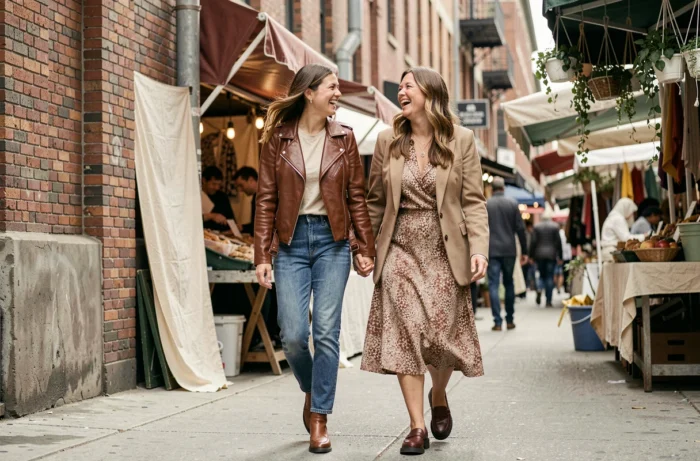
Fashion accessories: the detail that elevates an outfit from ordinary to noteworthy
A well-chosen accessory often costs less than a complete outfit and transforms a silhouette more effectively. Scarves, glasses, or belts are classics, but their effectiveness depends on how they direct the gaze.
The accessory acts as a visual tension point: it draws the eye to a specific area. A short necklace directs attention to the face. A belt defines the waist. A watch or a chunky bracelet draws the eye to the hands.
- Choose the area you want to highlight before selecting the accessory.
- Limit yourself to a maximum of two visible accessories to avoid overload.
- Vary the textures between the accessory and the garment (metal on matte fabric, leather on knit) to create depth.
This reasoning replaces the logic of accumulation with a logic of precision. One well-placed accessory has more impact than five stacked.
Fashion trends evolve quickly, but the principles that underpin a personal style remain stable: durable pieces, thoughtful color combinations, controlled volume, and targeted accessories. By integrating the European regulatory dimension that pushes for more repairable and traceable garments, each trendy purchase also becomes a reasoned one.